
Young people across Western Australia are gaining timely, flexible mental health support through MOST (Moderated Online Social Therapy), with an independent evaluation finding that the platform is being used and regarded as safe and acceptable by user and practitioners. The evaluation also found high satisfaction and improvements over time in measures of anxiety, depression and wellbeing among young people enrolled in MOST.
Developed and operated by Orygen’s digital mental health division, MOST is an online youth mental health platform co-designed by young people, practitioners and researchers. It combines therapeutic content, a moderated peer community, and clinical, peer and vocational support for people aged 12 to 25.
WA Primary Health Alliance (WAPHA) commissioned Orygen in 2024 to deliver MOST across WA through referrals from headspace, with plans to extend access through other primary care pathways, including general practice. Designed to complement existing care, the service enables headspace practitioners to connect young people with free, immediate online support.
To understand how the platform was being used and assess its implementation and reported outcomes, WAPHA commissioned The Kids Research Institute Australia to independently evaluate MOST’s implementation in WA from August 2024 to December 2025. The evaluation considered whether the platform was accessible, safe and beneficial for young people referred through WA headspace services.
The mixed-methods evaluation drew on quantitative data from 986 consenting WA users, supplied by Orygen Digital, alongside qualitative research by The Kids Research Institute Australia. Recruitment challenges and low response rates among young people, parents and carers meant the qualitative analysis was limited to interviews with 13 practitioners from nine metropolitan and regional headspace sites. The detailed qualitative findings therefore largely reflect practitioner perspectives.
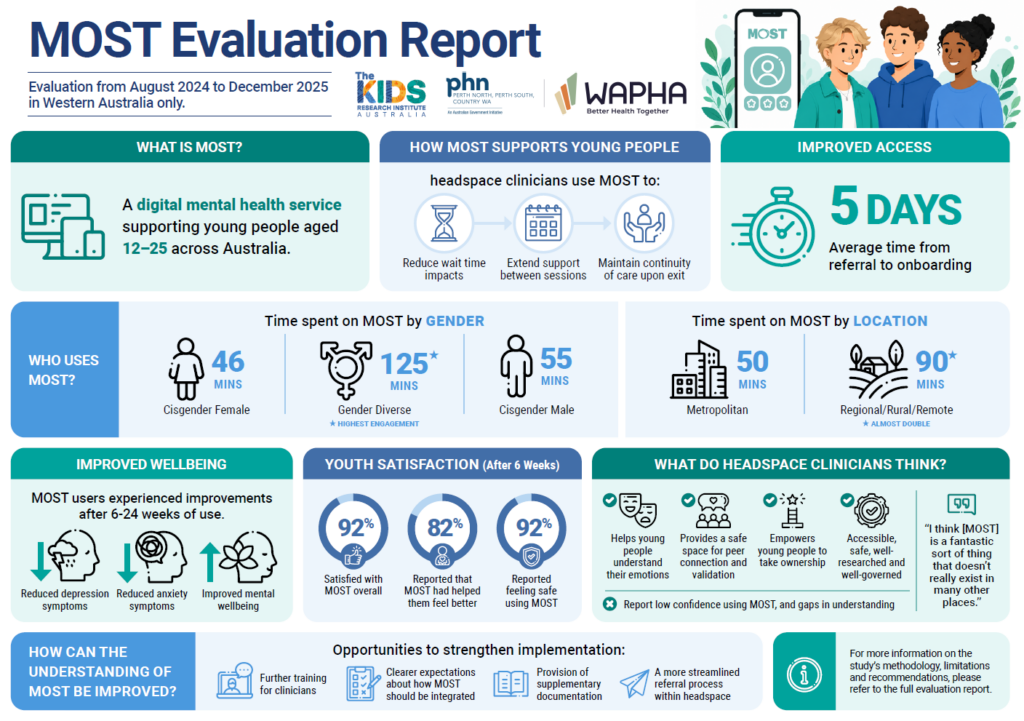
The findings point to timely access, moderate engagement and high user satisfaction, as well as improvements over time in measures of anxiety, depression and wellbeing. Platform data showed that young people used the therapeutic content and social network and connected with clinicians, peer worker and vocational workers. Young people reported feeling safe using MOST, while headspace practitioners generally viewed MOST as a safe, accessible and useful addition to care.
Measures of anxiety, depression and wellbeing also improved over time among young people using the platform. While the evaluation was not designed to determine whether the use of MOST underpinned these changes, the findings provide a reasonable basis for further monitored expansion of access to MOST as a beneficial adjunct within a broader care context, with continued active monitoring of uptake and outcomes evaluation also identified opportunities to strengthen implementation. Training uptake, practitioner confidence, workflow integration and understanding of shared-care arrangements varied across sites and roles, Differences between some practitioner perceptions and observed patterns of client use also suggest that practitioners do not always have a clear view of how young people engage with MOST following referral.
Overall, the findings indicate that MOST is most likely to be integrated consistently when practitioners receive practical onboarding and implementation support and when the platforms is embedded in routine care rather than left to individual headspace practitioners’ discretion.
Orygen Digital engaged opening and constructively throughout the evaluation process and responded positively to its findings. The evaluation has informed ongoing improvements to practitioner training and early implementation support, as well as WAPHA’s expansion of the provision of routine access to MOST to general practice in WA.
This activity is supported by funding from the Australian Government under the PHN Program and commissioned by WA Primary Health Alliance.